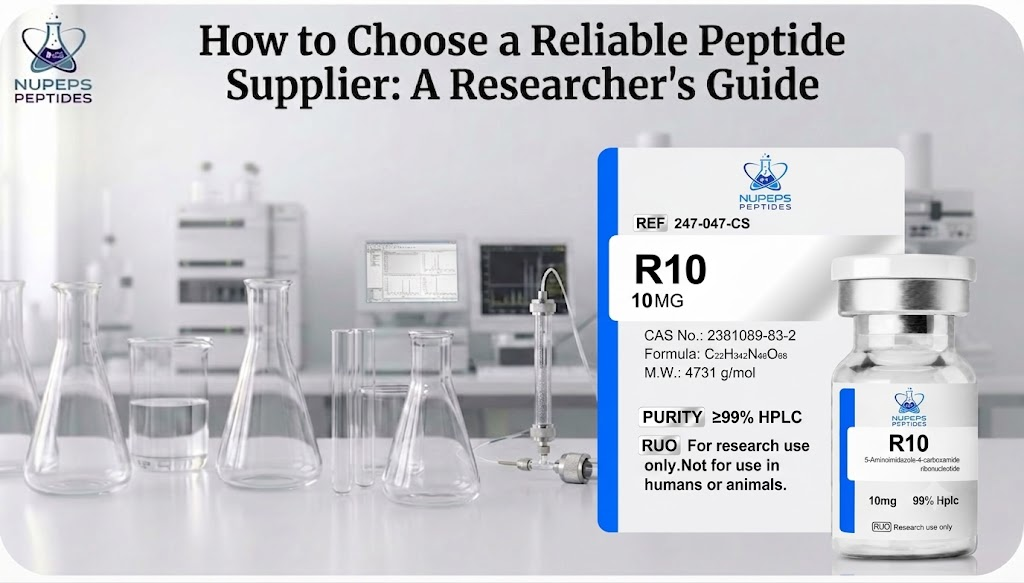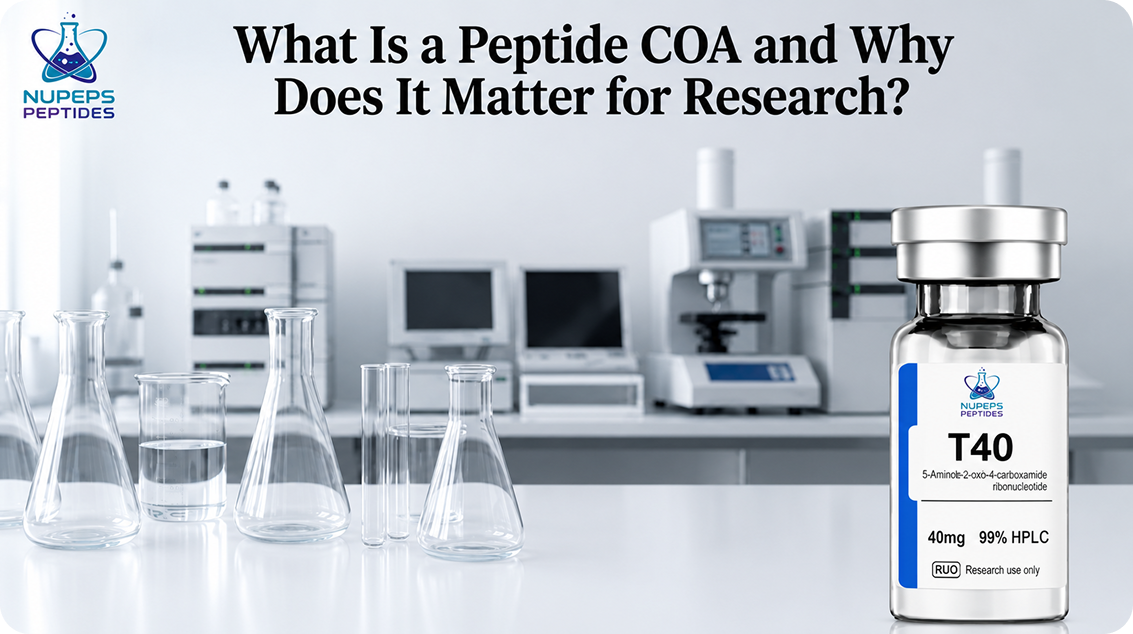
When you’re buying research grade peptides, one document matters more than any marketing claim or product description: the peptide COA.
A Certificate of Analysis, often called a COA, is the testing data behind the peptide product. It helps researchers verify peptide identity, peptide purity, quality, and compliance with established specifications. Without a reliable peptide COA, it’s hard to know if a peptide batch is research grade.
Many researchers focus only on purity percentages and overlook other critical data. A peptide may look highly pure on paper but still have issues that can affect research outcomes.
In this guide, you’ll learn what a peptide COA is, what should be in it, how testing works and why reviewing certificates of analysis is a best practice in peptide research.
A peptide COA is a document that summarizes the results of quality control testing done on a peptide batch.
The certificate is issued by the quality control department and may also include results from independent labs or third party testing facilities.
Its main purpose is to confirm a peptide meets defined quality standards before researchers use it in experiments.
A peptide COA verifies:
Think of a COA as the peptide’s report card. It’s the data researchers need to evaluate if a batch meets expectations for research.
In peptide research, reproducibility matters.
If researchers can’t trust the materials used in a study, the results become less reliable. That’s why certificates of analysis are so important.
A well documented peptide COA helps:
Without supporting documentation, researchers have to rely on a supplier’s claims.
A good supplier should provide COAs for every batch and make them available to review before purchase.
Not all COAs are created equal.
A good peptide COA should have several important pieces of information.
Every peptide batch should have a unique batch number.
This number allows researchers to trace a product back through manufacturing and testing records.
Batch traceability is part of quality control and regulatory compliance.
The certificate should confirm the peptide identity.
Researchers need to be sure the product they receive is the intended amino acid sequence.
Identity testing verifies the research compounds manufactured were correct.
Molecular weight confirmation is another quality indicator.
The reported molecular weight should match the theoretical value for the peptide sequence.
This confirms the peptide was synthesized correctly.
One of the most reviewed values on a peptide COA is the purity percentage.
A 98.7% purity typically means high peptide quality.
But researchers should know what that number actually means.
Purity percentage measures the chemical similarity of the peptide batch to detected impurities.
While purity is important, it’s not the only measurement that matters.
Many researchers assume a higher purity percentage means a better product.
The reality is more complex.
High Performance Liquid Chromatography, commonly known as HPLC, is the standard testing method used to quantify peptide purity.
HPLC separates the target peptide from impurities.
The analysis determines:
But HPLC purity only measures UV absorbing organic impurities.
It doesn’t detect all contaminants.
This is important because researchers often interpret HPLC values as total purity.
In reality, HPLC is only one part of a complete quality assessment.
This is one of the most misunderstood concepts in peptide research.
A peptide can test 99% pure and contain significantly less actual peptide by weight.
For example:
Why?
Because water content, residual solvents, salts and other materials can affect how much actual peptide is in a sample.
That’s why researchers should look beyond purity percentage alone.
Another important section of a peptide COA is Mass Spectrometry testing.
While HPLC measures purity, mass spectrometry measures identity.
Mass spectrometry helps:
In short, HPLC tells you how clean the sample is.
Mass spectrometry helps confirm the peptide is actually the peptide you ordered.
Together, these tests give you a better picture of product quality.
One question to always ask:
Was the peptide tested by an independent lab?
A third party COA gives you unbiased verification of peptide quality.
Independent labs test without being involved in manufacturing.
This reduces conflict of interest and increases confidence in results.
Benefits of third party testing include:
For many researchers, third party testing is a best practice when buying research grade peptides.
Premium research peptides often have extra testing beyond HPLC and mass spectrometry.
Heavy metals testing detects contaminants that can affect research outcomes.
This testing is commonly performed using:
Inductively Coupled Plasma Mass Spectrometry (ICP-MS)
The method can detect contaminants at parts per billion levels.
Researchers use this to find trace amounts of unwanted materials.
Endotoxins are substances produced by certain bacteria.
Although endotoxins are not infectious, they can trigger immune reactions.
Testing is done using:
Limulus Amebocyte Lysate (LAL) Assay
For some research applications, endotoxin testing is a quality and safety measure.
Not all certificates provide useful information.
Here are the red flags to watch out for.
A missing batch number makes traceability difficult.
Reliable certificates should clearly show testing results and specifications.
Without identity confirmation, researchers have limited assurance that the peptide was synthesized correctly.
Third party COAs generally provide greater credibility than internal reports alone.
Claims of perfect purity without supporting data should be reviewed carefully.
Reliable suppliers provide transparency, not marketing hype.
Before buying peptide products, review the certificate carefully.
Ask these questions:
✓ Is the batch number listed?
✓ Is HPLC data available?
✓ Is the batch number listed?
✓ Is mass spectrometry included?
✓ Is molecular weight correct?
✓ Is purity percentage reported?
✓ Is there third party testing?
✓ Are heavy metals or endotoxin tests included when necessary?
✓ Is the document from a reputable testing lab?
If the answer to several of these questions is no, further investigation may be necessary.
A good peptide supplier does more than sell research peptides.
They provide transparency, documentation and support.
Researchers should expect:
These factors build long term trust between suppliers and researchers.
Reviewing a peptide COA is important, but confirming the accuracy of the information is even more valuable. Before buying research grade peptides, take a few minutes to confirm the COA is real and contains useful data.
Start by checking the batch number. The batch number on the COA should match the batch number of the product. This proves traceability and that the COA is for the specific peptide you are buying.
Next check the testing methods used. A good COA should have HPLC for purity and Mass Spectrometry for identity. If these are missing, ask for more information.
Look at the testing lab too. Third party COAs from independent labs have more credibility than internal COAs. Independent testing reduces bias and increases transparency.
Verify the purity percentage, molecular weight and product specifications are reasonable and consistent. For example, a peptide with 98.7% purity with HPLC and mass spectrometry data is generally good quality.
Watch out for red flags like missing testing dates, incomplete results, generic COAs used for multiple products or documents with no lab info. Good suppliers make it easy to review COAs and answer questions about their testing.
Taking these simple verification steps helps researchers make better purchasing decisions and reduce the risk of buying poorly documented or inadequate peptide products.
A peptide COA, or Certificate of Analysis, is a quality control document that provides detailed testing results for a specific peptide batch. It helps researchers verify peptide identity, peptide purity, molecular weight, and other important specifications before using a product in scientific research. Reviewing a peptide COA is one of the best ways to confirm that research grade peptides meet established quality standards.
A peptide COA is important because it provides the data researchers need to evaluate the quality and reliability of peptide products. Certificates of analysis help confirm peptide identity, purity levels, and testing results, making it easier to reproduce experiments and maintain research integrity. Without a reliable COA, researchers have limited information about the materials being used in their studies.
Most peptide COAs include High Performance Liquid Chromatography (HPLC) to measure peptide purity and Mass Spectrometry to confirm peptide identity. Depending on the application, a certificate may also include heavy metals testing, endotoxin testing, molecular weight verification, and third party testing results. These testing methods provide a more complete picture of peptide quality and product specifications.
Peptide purity measures how much of a sample consists of the target peptide compared to detectable impurities. Net peptide content, on the other hand, shows how much actual peptide is present in the sample by weight. For example, a peptide may test at 99% purity through HPLC analysis while having a lower net peptide content due to water, salts, or residual materials. Understanding both values helps researchers make more informed purchasing decisions.
Third party COAs provide independent verification of peptide quality through testing performed by external laboratories. Because the testing lab is separate from the manufacturer, the results are generally viewed as more objective and transparent. Third party testing helps researchers verify peptide purity, confirm identity, and gain greater confidence in the quality of research grade peptides before purchase.
A peptide COA is one of the most important tools researchers can use when buying peptide products. It helps to verify peptide identity, confirm peptide purity, review testing results and assess quality before research starts.
Rather than focusing only on purity percentage, researchers should evaluate the complete peptide COA. HPLC, mass spectrometry, batch number, molecular weight confirmation, heavy metals testing, endotoxin screening and third party testing all contribute to a complete picture of product quality.
At NuPeps, we believe in transparency and quality control. Our commitment to research grade peptides, rigorous testing methods and detailed documentation helps researchers to buy research peptides with confidence. Browse our peptide catalog or contact us to learn more about our quality standards and testing process.
Peptides are short chains of amino acids used in scientific research to study biological pathways, mimic protein regions, and support assay and method development.