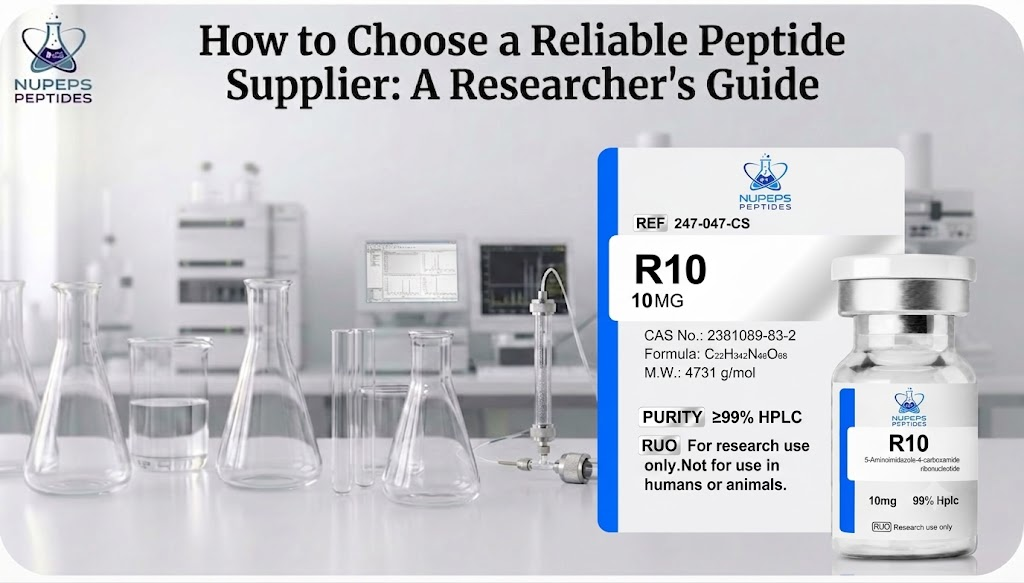
Choosing a reliable peptide supplier is one of the most important decisions a researcher can make. Whether you’re sourcing lab grade peptides for biological studies, compound development or laboratory analysis, product quality directly impacts your results. With hundreds of suppliers online, finding a trustworthy source requires careful evaluation of testing standards, transparency and regulatory compliance.
Not all peptide suppliers have the same quality standards. Some provide batch specific Certificates of Analysis, third party testing and detailed quality control documentation, while others offer little transparency about their products.
This guide will show you how to evaluate a peptide supplier, verify product quality and choose premium research peptides that support scientific research.
Peptides are involved in many physiological processes and scientific applications. Researchers use peptides to investigate biological mechanisms, develop new compounds and explore new treatment pathways.
Some commonly researched peptides include:
Don’t choose a supplier based on price alone. Research outcomes depend on product integrity.
A good supplier ensures:
When quality standards are lacking, researchers risk inaccurate analysis, wasted resources and compromised scientific findings.
One of the most important qualities of a good peptide supplier is transparency.
Reliable suppliers openly provide information about:
If a supplier hides critical information or makes vague claims, it’s a red flag. Transparent suppliers let researchers view batch records and documentation easily on the website.
A good supplier should clearly explain how peptides are manufactured, tested, packaged and delivered.
Transparency shows a genuine commitment to quality and scientific research.
Independent testing is one of the strongest indicators of product quality.
Every batch should undergo third party testing by an accredited laboratory.
Third party testing verifies:
Without independent verification, researchers have no way to confirm product specifications.
When evaluating a peptide supplier, ask if they provide batch specific testing reports from named laboratories.
Generic reports or outdated documentation should raise concerns.
A good peptide supplier should provide Certificates of Analysis, often called CoA’s, for every batch.
These are essential for scientific verification.
A proper CoA should include:
Batch specific CoA’s create a clear chain of custody from manufacture to delivery.
Researchers should avoid suppliers that display the same certificate across multiple batches or provide incomplete documentation.
Not all peptide suppliers have the same quality standards. Researchers should watch for warning signs that may indicate poor quality control or lack of transparency.
Common red flags include:
Identifying these issues early can help researchers avoid unreliable products and protect the integrity of their work.
Purity affects research accuracy.
Most premium research peptides are expected to meet high purity standards, above 95%.
Researchers should evaluate purity claims carefully.
Many websites advertise 100% purity but experienced scientists know that absolute purity is chemically impossible.
Instead, good suppliers provide realistic and verifiable purity levels supported by testing data.
The number itself is not the key but the evidence behind the claim.
High Performance Liquid Chromatography, HPLC, is one of the most important testing methods in peptide analysis.
HPLC testing helps determine:
A good supplier should provide HPLC chromatograms whenever possible.
Researchers should review these reports rather than relying on marketing claims.
Mass Spectrometry, MS, is another verification method.
MS confirms the peptide being tested matches the intended molecular structure.
The combination of:
provides strong evidence that a peptide meets quality standards.
Good Manufacturing Practice certification demonstrates that products are manufactured under controlled conditions.
A supplier that follows GMP standards typically maintains:
For researchers, this consistency reduces variability between batches.
ISO certifications indicate adherence to internationally recognized quality management systems.
One important benchmark is:
ISO 9001:2015 Compliance
This certification demonstrates a structured approach to quality control and operational excellence.
When comparing suppliers, certifications can provide valuable insight into their commitment to quality, especially when products are tested and verified in the usa.
Researchers should understand an important distinction regarding peptides.
Research Use Only peptides are not intended for human therapeutics or clinical trials.
Legitimate suppliers clearly state that their products are intended solely for:
These peptides are not approved for human therapeutic use or human consumption.
Legitimate research suppliers clearly label products for research use only and avoid promoting them for human consumption.
A responsible peptide supplier follows regulatory requirements, clearly communicates intended use, and requires buyers to agree that products are for research use only.
The FDA maintains strict guidelines regarding the sale, labeling, and distribution of peptides.
Reliable suppliers understand and comply with these requirements.
Look for suppliers that:
Compliance reflects professionalism and helps protect both researchers and institutions.
Many peptides are temperature sensitive.
Exposure to heat or moisture can affect product stability and integrity.
A reliable peptide supplier should use appropriate cold chain shipping methods when necessary.
This may include:
Proper handling ensures peptides arrive in optimal condition.
Before placing an order, researchers should review storage recommendations.
Quality suppliers provide guidance on:
Storage recommendations should also specify the correct place for refrigeration or freezer storage to protect peptide integrity.
This information helps maintain peptide integrity throughout the research process.
Before selecting a peptide supplier, ask these critical questions:
The answer should always be yes.
Independent verification is essential.
Reliable suppliers should make this information available.
Transparency about manufacturing facilities is important.
Look for GMP practices and ISO compliance.
Proper shipping protects peptide quality.
For injectables used in research environments, endotoxin testing is especially important for safety and product evaluation.
Premium research peptides often provide advantages beyond purity alone.
Benefits may include:
For laboratories conducting sensitive studies, these factors can significantly impact outcomes.
Although lower priced products may seem attractive, investing in quality often reduces long term research costs.
When evaluating a peptide supplier, remember:
Researchers who do their due diligence get better products and better results.
Look for transparency, third party testing, batch specific Certificates of Analysis, HPLC testing, MS verification, and compliance with quality standards such as GMP and ISO 9001:2015.
Lab grade peptides are peptides manufactured and tested specifically for scientific research. They are intended for research use and not for human consumption.
Third party testing independently verifies purity, potency, and identity. It helps researchers confirm product quality and reduces the risk of inaccurate specifications.
A CoA should include the batch number, purity level, HPLC results, testing date, product identification, and the name of the independent testing laboratory.
HPLC testing evaluates peptide purity and identifies impurities. It is one of the most widely accepted methods for verifying peptide quality in scientific research.
Selecting the right peptide supplier requires more than comparing prices. Researchers should prioritize transparency, batch specific CoAs, HPLC verification, MS testing, and independent third party analysis when evaluating potential suppliers.
At NuPeps, we understand the importance of consistency, quality, and documentation in scientific research. Our commitment to premium research peptides, rigorous testing standards, and reliable support helps researchers source lab grade peptides with confidence. Explore our collection of research peptides or contact our team with any questions about your research needs.

Peptides are short chains of amino acids used in scientific research to study biological pathways, mimic protein regions, and support assay and method development.